Verizon Q3 2026 Earnings: Profit Beat, Revenue Miss
Verizon's Q3 2026: revenue $34.3B up 1.5%, adjusted EPS $1.31 up 8.3%, record EBITDA, and guidance raised for a third straight quarter.
Verizon reported third-quarter 2026 results on October 26 that split in two directions: profit came in ahead of expectations while revenue came in short. Total operating revenue was $34.31 billion, up 1.5% from a year earlier, and adjusted earnings per share were $1.31, up 8.3% from $1.21. The company also added more phone customers than in any third quarter in five years and raised its full-year guidance for the third consecutive quarter.
Adjusted EPS of $1.31 was reported versus a consensus of $1.27 as compiled by Zacks. Revenue of $34.31 billion was reported versus a consensus of $34.81 billion as compiled by Zacks. On a GAAP basis, net income was $5.3 billion, up 5.2%, and diluted EPS was $1.25, up from $1.17 a year earlier. The net income margin was 15.5%, compared with 14.9% in the third quarter of 2025.
The quarter in numbers (consensus: Zacks estimates cited above):
| Metric | Q3 2026 | vs. year earlier |
|---|---|---|
| Total operating revenue | $34.31B | +1.5% |
| Adjusted EPS | $1.31 | +8.3% |
| GAAP diluted EPS | $1.25 | up from $1.17 |
| Net income | $5.3B | +5.2% |
| Adjusted EBITDA | $13.80B | +8.0% (company record) |
| Operating income | $8.65B | +6.7% |
| Free cash flow | $7.80B | +12.1% |
Where the growth came from
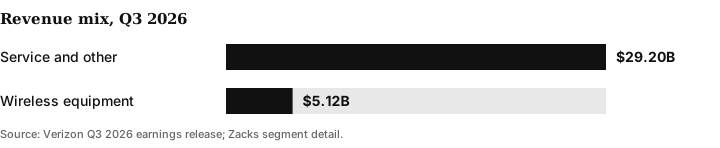
Almost all of the growth was in services, not devices. Service revenues and other rose 3.5% to $29.20 billion. Mobility and broadband service revenue, the recurring monthly charges from phone and internet customers, reached about $23.5 billion, up 2.9%. That growth rate has improved through the year, from 1.6% in the first quarter to 2.8% in the second quarter and 2.9% in the third, according to the company’s release.
Wireless equipment revenue moved the other way, falling 9% to $5.12 billion. The company attributed the decline primarily to significantly lower upgrade volumes, as customers keep their phones for longer, and to its own decision to spend less on device subsidies. In other words, Verizon sold fewer phones at lower promotional cost, and total revenue still grew because the service side grew faster.
Customer numbers were the strongest part of the report:
- Postpaid phone net additions were 406,000, up from 44,000 a year earlier, which the company described as its strongest third-quarter performance in five years.
- Postpaid net account additions were 137,000, which the company described as its strongest quarterly account growth in over a decade.
- Overall postpaid phone churn, the share of customers who leave each month, improved to 0.94%, while Consumer postpaid phone churn improved to 0.87%.
- Broadband net additions were 314,000, split between 159,000 fixed wireless access additions and 155,000 fiber additions, taking total broadband connections to 17.4 million.
By segment, Consumer operating revenue rose 1.3% to $26.43 billion, and Consumer operating income rose 5.6% to $8.09 billion. Business operating revenue rose 2.6% to $7.02 billion, and Business operating income rose 19.4% to $855 million, helped by lower selling, general and administrative expenses.
| Segment | Revenue | Change | Operating income | Change |
|---|---|---|---|---|
| Consumer | $26.43B | +1.3% | $8.09B | +5.6% |
| Business | $7.02B | +2.6% | $855M | +19.4% |
Why profit grew faster than revenue
Revenue rose 1.5%, but operating income rose 6.7% to $8.65 billion, and adjusted EBITDA, a measure of operating profit before depreciation, amortization, interest and taxes, rose 8.0% to a company-record $13.80 billion. The adjusted EBITDA margin expanded to 40.2%, from 37.8% a year earlier.
The release and the reported figures point to cost discipline as the main reason. Total operating expenses fell 0.2% to $25.66 billion, and selling, general and administrative expenses fell 3.5% to $7.48 billion. The company said its promotional cost of acquisition fell 41% year over year and its promotional cost of retention improved by 30%. Chief executive Dan Schulman attributed the approach to prioritizing customer offerings such as Simplicity and an expanded loyalty program over heavy subsidies, in management’s own description of the strategy.
That framing matters for reading the quarter. A carrier can add customers by discounting phones heavily, which lifts subscriber counts and equipment revenue while pressuring profit. Verizon’s reported pattern this quarter was the reverse: fewer equipment sales, lower promotional spending, more customers, and wider margins.
Cash flow, spending, and debt
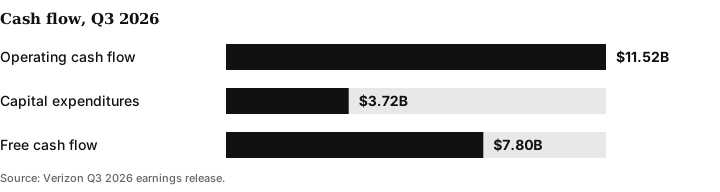
Cash generation was solid in the quarter. Operating cash flow was $11.52 billion, up 2.2%. Capital expenditures were $3.72 billion, down from $4.31 billion a year earlier, leaving free cash flow, the cash left after capital spending, at $7.80 billion, up 12.1%.
For the first nine months of the year, capital expenditures were $11.9 billion and free cash flow was $18.01 billion, up 14.3%. Verizon returned $12.8 billion to shareholders in that period, up 49.0%, made up of $8.8 billion in dividends and $4.0 billion in share repurchases. The company said it still expects repurchases of up to $4.5 billion for the full year. Net debt was $123.72 billion at quarter-end, or 2.3 times adjusted EBITDA, improved from the prior quarter.
The company also announced an agreement valued at more than $2 billion with Amazon Web Services. The agreement sets a commercial framework to scale distributed computing for the real-time demands of AI workloads, using Verizon’s fiber network. Verizon said it still expects total fiber passings to exceed 32 million by year-end, on a path toward 40 to 50 million over the medium term.
Guidance raised again
Verizon raised its full-year 2026 outlook for adjusted EPS to $5.04 to $5.06 per share, implying growth of 7% to 7.5%, up from its previous growth projection of 6% to 7%. It was the third consecutive quarterly increase to guidance, according to the company.
Two operating forecasts moved up with it. Postpaid phone net additions for the full year are now expected at 1.1 million to 1.2 million, up from a previous range of 875,000 to 1 million. Mobility and broadband service revenue growth is now expected in the upper half of the 2.5% to 3.0% range, with growth of about 4.0% forecast for the fourth quarter alone. Free cash flow growth is now projected to approach 12%. Capital expenditure guidance was left unchanged at $16 billion to $16.5 billion.
What to watch next quarter
Three open items carry into the fourth quarter. First, whether mobility and broadband service revenue growth reaches the roughly 4.0% the company forecast for the quarter, after three quarters of gradual improvement. Second, whether postpaid phone additions stay near this quarter’s pace without promotional spending rising again; the full-year target of 1.1 million to 1.2 million additions will be tested against the holiday selling season, when carriers usually spend the most to win customers. Third, whether fiber passings pass the 32 million mark the company set for year-end, and how much of the new AWS agreement shows up in Business segment results.
Readers who keep cash in interest-bearing accounts while they watch earnings season may also want our comparison of high-yield savings vs. money market accounts and our guide to how many months an emergency fund should cover.
Bottom line
Verizon’s third quarter was a margin and subscriber story, not a revenue story. Service revenue grew steadily, equipment revenue fell by design, promotional costs dropped, and profit and free cash flow grew much faster than the top line. The raised guidance, the third increase in a row, rests on the same claim management made in the release: that customers can be won with simpler offers and loyalty benefits rather than larger phone subsidies. The fourth quarter, with its heavier seasonal promotions, is the next test of that claim.